

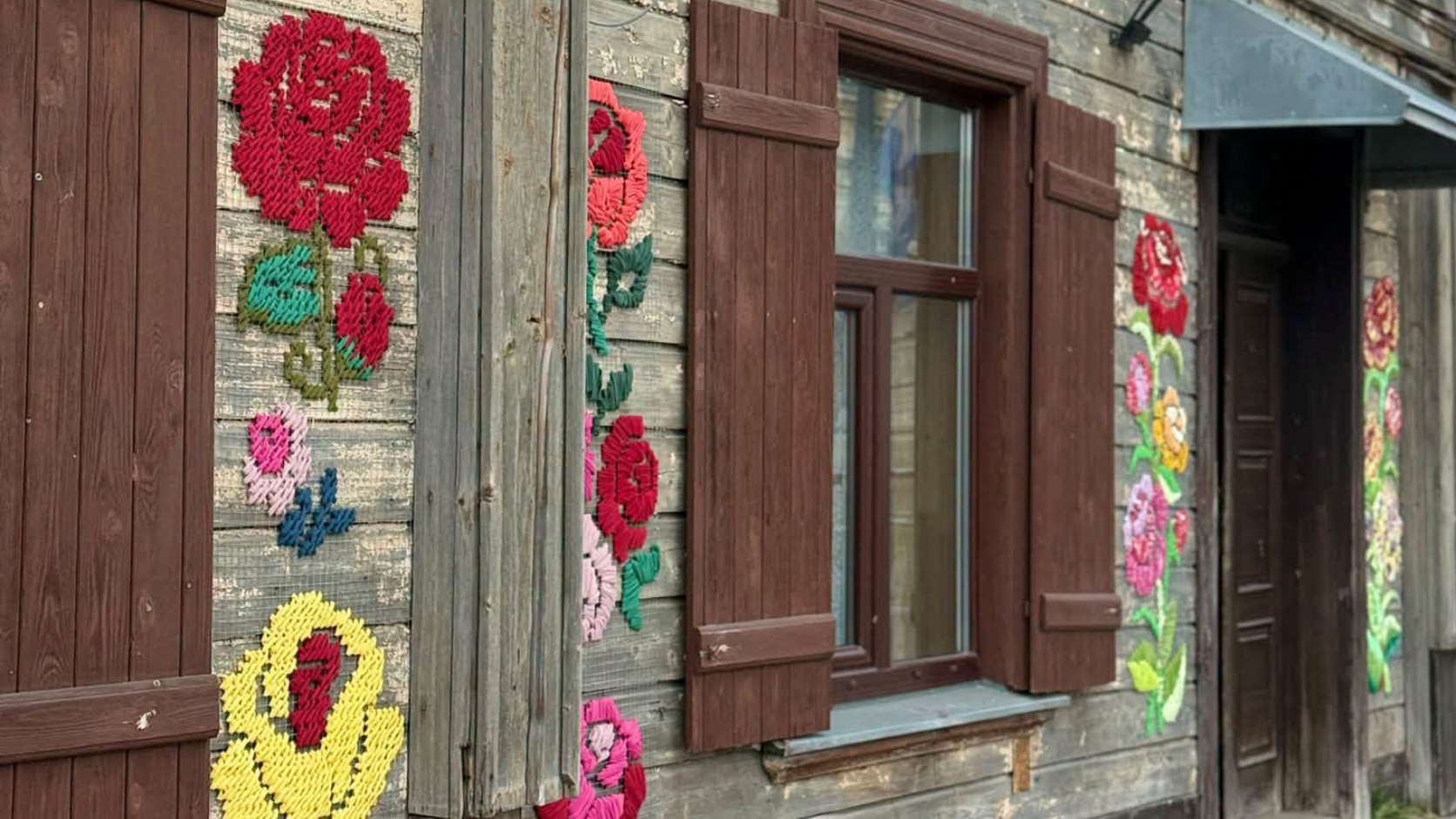
As Latvia’s national holiday approaches, the buildings in Bauska’s Old Town are once again adorned with colourful, hand-made roses. Thanks to the initiative and dedication of Laura Matilde Ikerte and the helpful ‘rose godmothers’, a tradition begun nine years ago has been revived, becoming one of the hallmarks of Bauska’s Old Town. This time, the roses have been created entirely by the volunteers themselves – investing their own time, materials and labour.
The story of the roses in Bauska’s Old Town began in 2017, when, as part of the ‘Let’s Bloom Together’ project, the buildings on Rīgas Street were adorned with nearly 70 magnificent rose decorations. A total of 130 craftspeople from the Bauska district took part in creating them.
Laura Matilde Ikerte had seen the idea of decorating houses with flowers whilst in Spain, whilst the rose was chosen as a symbol closely linked to the cultural and historical heritage of Zemgale.
“Our local poet, Vilis Plūdons, wrote the poem ‘Of all the flowers, my dearest are the dark-red roses’, and Zemgale skirts do, after all, feature a rose pattern, which is what sets them apart from others,” said Laura Matilde Ikerte, the creator of the ‘Let’s Bloom Together’ project, at the time.
The magnificent roses were crafted from worn-out items of clothing, thus giving the fabric a new lease of life. It was clear from the outset that the lifespan of the decorations would depend on the weather conditions and the care taken by the residents themselves.
Initially, the project in Bauska did not receive financial support, but it was successfully implemented with funding from the Zemgale Planning Region. Later, a partnership was established with Bauska District Council, and, with the support of the residents’ initiative project competition ‘Residents Shape Their Environment’, various plans for the improvement and beautification of the old town were carried out: the restoration of rose beds, and the creation of mosaic and tiled decorations.
Over the years, the roses were restored and replenished, but the sun, rain and wind gradually took their toll. Some of the decorations had faded, raising questions about their future.
The roses’ "godmothers" – a shared commitment to preserving Bauska’s symbol.
Although some of the roses had lost their original splendour, local residents called for them to be preserved, emphasising that the roses had already become a symbol of Bauska.
Laura Matilde Ikerte found new inspiration at a librarians’ meeting, where, whilst talking about the project and the need to renew the decorations, she met some enthusiastic women who were ready to get involved and organise the making of roses in their own libraries too.
As Latvia’s national holiday approached, a decision was made to present Bauska and Latvia with a special bouquet of flowers. A campaign entitled ‘Looking for rose godmothers’ was launched on Facebook, inviting everyone to get involved in restoring the roses.
The initiative was based on a desire to share out the work, responsibilities and costs so that everyone could make their own contribution – from purchasing materials, cutting the wire mesh and preparing the designs, right through to making the roses and attaching them to the building façades.
The response was overwhelming. More than 20 participants from Bauska, Piņķi, Riga, Misa, Baldone and other places attended the rose-making masterclass at the Bauska Cultural Centre. To ensure that those who were unable to attend in person could also take part, a video tutorial was produced, which is available on the Facebook group “Rozes Bauskas namiem”.
The courtyard of the Bauska Museum became the venue for joint meetings and organising the work. Not only the ‘godmothers’ but also the ‘godfathers’ got involved in restoring the roses, helping to put up the decorations.
Everything that had been planned had to be completed in about a month and a half so that the new roses would have time to bloom before Latvia’s national holiday.
Our own time, materials and work..
On this occasion, the restoration of the roses took place as a voluntary community initiative without any specific project funding. The participants contributed their own funds, materials, skills and spare time.
Now, amongst the sun-bleached, artistically nuanced, ancient roses, there are also bright, new, spirited ones. “That’s how we do things – we come together in the name of an idea and get on with it. We don’t ask for anything in return; we simply do it. Our own time, our own materials, our own labour and immense joy,” says the initiative’s founder, Laura Matilde Ikerte.
Restoration work is still ongoing, and some roses are still waiting to be planted alongside the houses in Bauska’s Old Town. The exact number of people involved is not yet known, as the work was carried out on a voluntary basis, without participants being registered.
Alongside the new, vibrant roses, the older ones – whose colours have faded over time – have also been preserved. They form a significant part of this initiative’s history. Even the very first roses, planted almost ten years ago, still adorn the windows of Laura Matilde Ikert’s mother’s cottage.
Thank you to every rose "godmother" and "godfather" !
Bauska District Council would like to express its heartfelt gratitude to the initiative’s founder, Laura Matilde Ikerte, for her perseverance, creativity and contribution to preserving the unique character of Bauska’s Old Town.
Special thanks go to all the rose ‘godmothers’ and ‘godfathers’ who responded to the call, gave their time, donated materials, shared their skills and helped the roses to bloom once more!
Our thanks also go to the Bauska Cultural Centre for providing the venue for the masterclass, and to the Bauska Museum for allowing us to use its courtyard for our joint meetings and to organise our work.
This initiative demonstrates just how much can be achieved when people come together for a common goal. The roses in Bauska’s Old Town are not only magnificent decorations, but also a symbol of the residents’ creativity, perseverance and sense of belonging to their town.
Thanks to the people who care about Bauska, the roses in the Old Town continue to bloom.
Share