



Apraksts
One of the most significant assets of the town of Iecava is the park, created between 1795 and 1800, at the same time as the construction of the manor house (Residential building). The park is designed in the style of English landscape parks and, together with the manor complex, is an architectural monument of national importance. Up to nowadays, The Iecava Manor complex has only been partially preserved. The main building of the manor - the castle, was burnt down in July 1915 and was never rebuilt. However, several important buildings have been preserved: the Manor house library building, the granary (the barn), the stables, the gatekeeper’s houses of the park gates, the laundry house, and a stone bridge over the river Ģedule.
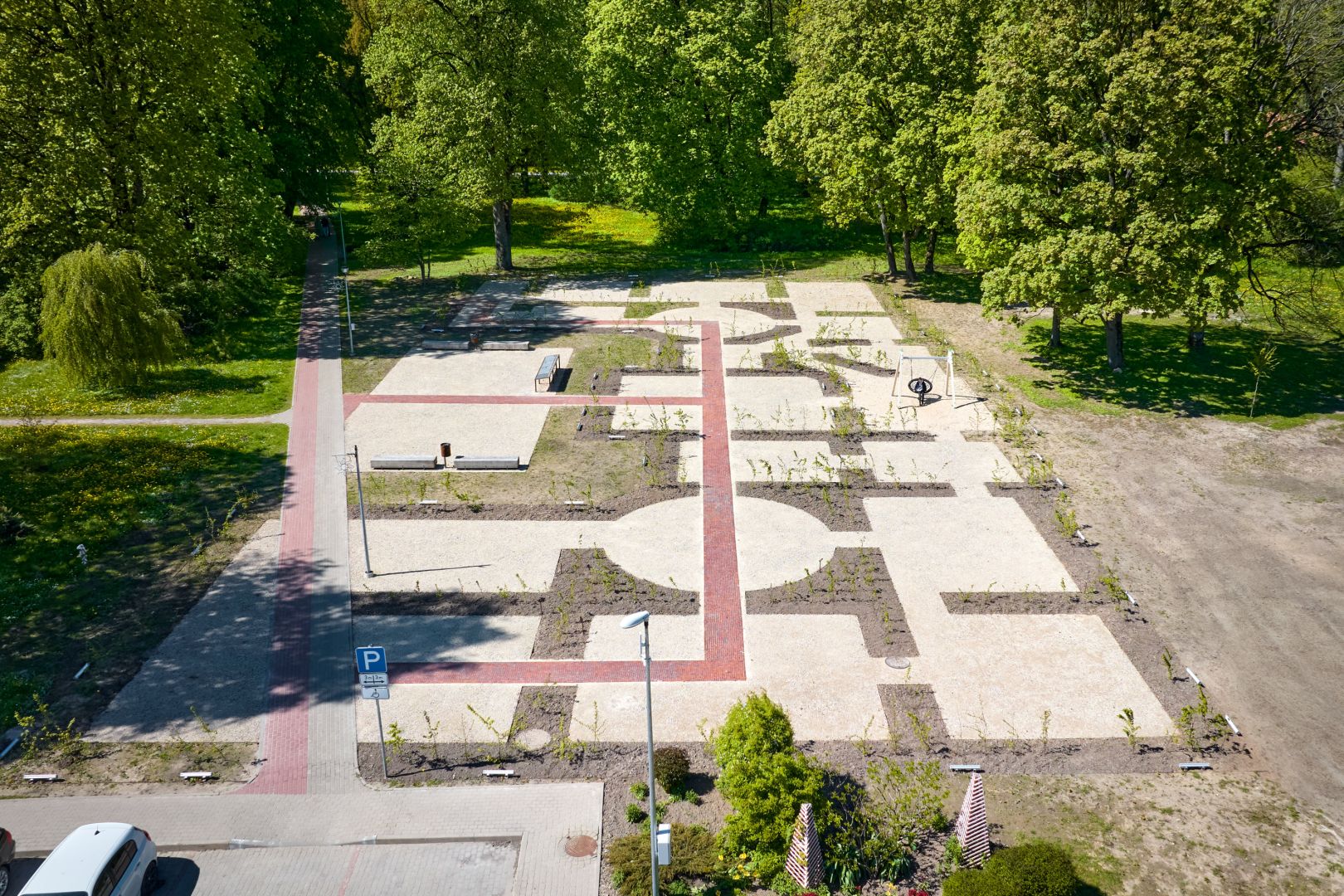
In order to make Iecava Park and its architectural ensemble an attractive tourist destination, elements of the 18th-century manor park ensemble (Manor house building, bird house, path layout, etc.) are to be gradually restored, but in a slightly different way. As part of the project, the outline of the Iecava Manor building with the layout of the rooms has been reproduced in the form of a hedge on the historic site of the manor in 2024. After the hedge has grown and taken shape, the object will become a "Green Maze," the idea of which was developed by the Latvian company 7 A.M. in collaboration with the Italian company AOUMM.
From the summer of 2025, the historical Iecava Manor can also be viewed in the mobile application "BAUSKA AR" - with the help of augmented reality, through the screen of your smartphone, you can experience the charm and scope of the ancient castle's history. Try it yourself!
About the Iecava Manor House
In 1795, Peter Graf von der Pahlen received Lieliecava Manor, which had been leased until then, as his serf’s property and began restoring the manor complex and creating a park.Unfortunately, there is no direct information about the construction of the Manor or its architect, but the available documents suggest that the manor was built between 1801 and 1807, by Johann Georg AdamBerlitz, but it is also possible that Severin Jensen was involved.
The exterior of the Manor house is relatively well-known from old photographs, but information about the interior can only be obtained from early 20th-century surveys, a few descriptions, and one known photograph.
During the First World War, in July 1915, the Manor was burnt down as the Russian army retreated. The best way to get and idea of the structure and decorations of the once luxurious interior of the manor is from the book "Iecava Manor" by Imants Lancmanis*.
* The entrance described is through the main doors located on the riverside facade, into room No. 6. You will enter through the doors that lead directly into the Central Festive Hall, room No. 16.
"The main body of Iecava Manor ran parallel to the river and consisted of a two-storey central part with seven bays, flanked by single-storey five-bay side wings. The central risalit, with its four Ionic order pilasters, was marked by a monumental staircase across its entire width. At the back of the building, the scene was very different. The side wings attached to the main block transformed the palace into a playful summerhouse, which was further emphasised by the intricate polygonal staircase (neo-Baroque from the second half of the 19th century) and the distinctive chamfered projections at the inner corners of the building, where the ionic columns repeated the motifs of the entrance portico of the main facade. The building, especially when viewed from an oblique angle, took on a complex play of volumes and forms, rarely found in Latvian manor architecture, which evoked more the mood of Baroque. [...]"
The plan shows a surprisingly presentable and impressive composition of the rooms, the only case in Latvia classical architecture where two round halls are used. […]
The interiors of the relatively small building took on a monumental character thanks to the very thoughtful grouping and sequencing of the rooms. Entering the foyer, the guest’s gaze was drawn to the four columns, but the path did not lead directly into the Great Hall.
To extend the procession through the series of parade rooms, the guest had to turn left, where he entered an anteroom with two corner fireplaces*. This is the only case in Courland – Semigallia architecture where two fireplaces have been created in a room for symmetry, and in Iecava Manor this technique was repeated in two other rooms: a small hall on the courtyard side and a salon on the park side, accessed from the aforementioned anteroom. The enfilade of park side spaces was designed to be particularly effective. The central ceremonial hall was connected on both sides by an open bay to two intermediate halls (similar to the one in Mežotne Palace), which in turn led into two circular halls.
The central hall, which ran through two floors, was a rare architectural solution. The room itself was a squere, but the diagonally placed pairs of columns at the corners and the break in the entablature gave the hall an octagonal appearance, and it was covered by a dome formed by eight sail vaults. A total of 16 columns of ionic order (half-columns in the depth of the hall) enclosed the hall from all sides, giving it a light and openwork impression. There was a fireplace in the wall of the hall facing the window. The observation shows that the column-bearing entablature was adorned with semicircular stucco threads, presumably containing either goat skulls - bucrania or mascaroni."**
**Imants Lancmanis, "Iecava Manor", Rundāle Palace Museum, 2001, pp. 13–18.
The round hall, the interior of which can be judged from the photograph, has niches for sculptures, the walls are divided by panno with delicate arabesque painting. Adjacent to the round hall was the dining room, a long room with three windows facing south-east. The dining room’s wall paintings use Egyptian motifs, which were fashionable in early 19th century in the Empire style. The kitchen and servants’ apartments were located on the ground floor.
The newest part of the Manor house, which has survived to the present day, is the library block designed by architect L. Reinir and built in 1908, where the architectural motifs of the manor are repeated, allowing guests to imagine what Lieliecava Manor castle building was like in the past. After the renovation in 2016, several departments of the municipality’s institutions are located here: the Iecavnīca Day Centre, the Iecava Youth Centre, and the Iecava Music and Art School.